Europe’s New EES: What Riders Should Know
At RiderCamTV Tours, we’ve spent years exploring Europe’s best motorcycle routes — from Spain’s mountain switchbacks to Norway’s coastal sweepers. And if there’s one thing we’ve learned, it’s that preparation is key to a great ride.
Now, with Europe’s New EES: What Riders Should Know, there’s an important update for anyone riding across European borders. The European Union is launching a new Entry/Exit System (EES) that changes how non-EU travellers enter and exit the Schengen Zone. It’s not difficult, but knowing the basics will help you cross borders smoothly — and keep your focus on the road ahead.
🛂 What Is the EES?
The Entry/Exit System (EES) is a new automated EU border control system replacing manual passport stamping for travellers entering or leaving the Schengen Area (most of mainland Europe).
Instead of passport stamps, your travel details will be recorded digitally, including:
-
Passport information
-
Date, time, and place of entry/exit
-
Biometric data (a facial image and fingerprints)
This new system aims to improve security, prevent overstays, and eventually make border crossings quicker once it’s fully operational.
📅 Launch date: The EES is expected to start on 12 October 2025, with full rollout by April 2026 across all Schengen border crossings.
👉 For more details, see the official EU information on the EES.
🏍️ What Does It Mean for Motorcycle Riders?
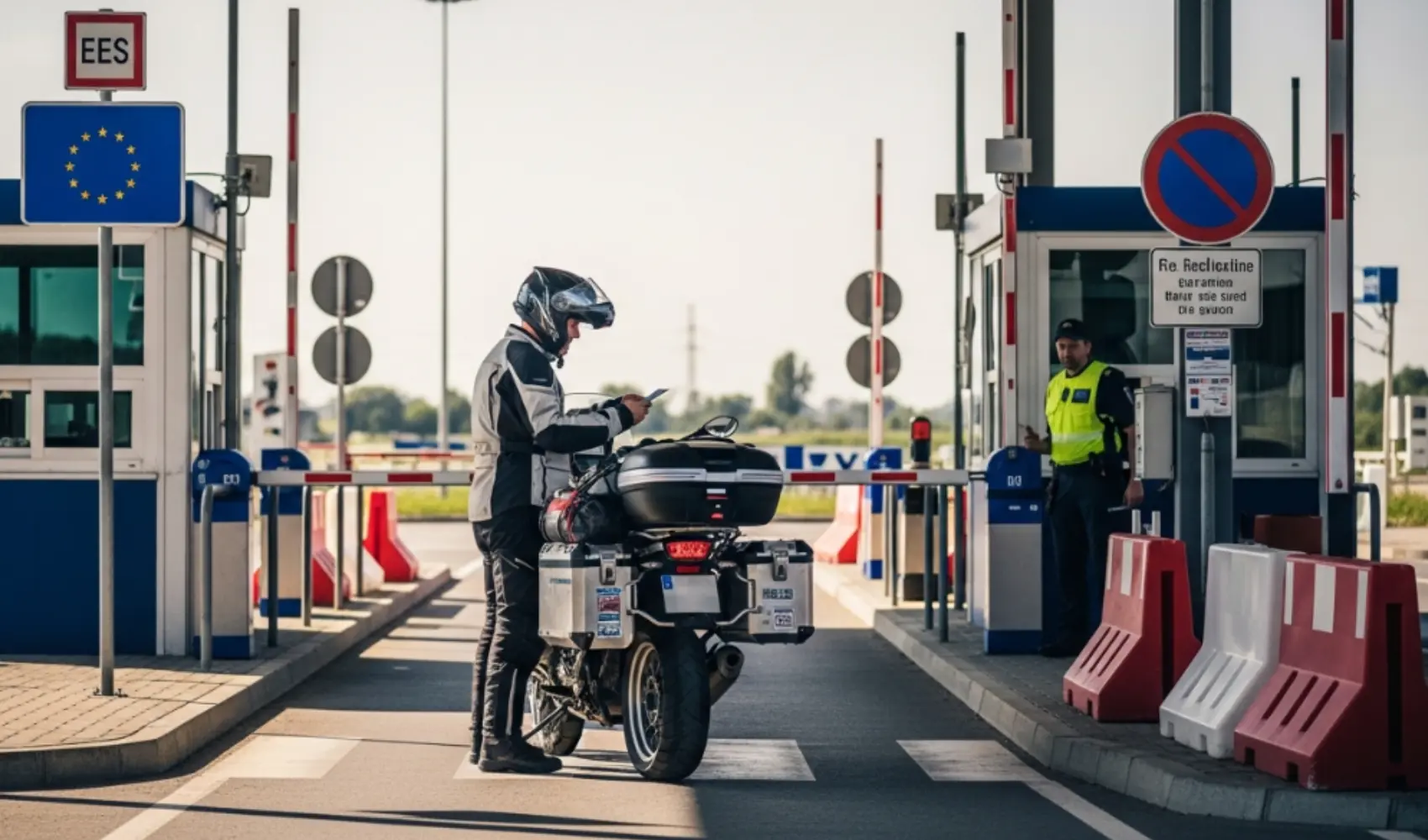
If you’re a non-EU rider — for example, from the UK, USA, Canada, or Australia — you’ll encounter this new process the first time you enter the Schengen zone.
Here’s how Europe’s New EES: What Riders Should Know affects your motorcycle adventures:
1. Expect Slightly Longer Border Checks
Your first entry into the Schengen zone will include biometric registration (a face scan and fingerprints). Future trips will be quicker once your data is stored.
If you’re crossing borders by ferry, Eurotunnel, or road — such as from the UK into France or Spain via Andorra — allow extra time, especially during the first months of rollout.
2. The EES Doesn’t Replace Your Travel Documents
The EES adds a digital layer — but you’ll still need all your regular paperwork:
-
Passport
-
Driving licence
-
Bike registration (V5C)
-
Insurance certificate
-
Breakdown and travel insurance
💡 RiderCamTV Tip: Keep these documents together in a waterproof wallet in your tank bag for quick access at border points.
3. The 90-Days-in-180-Days Rule Becomes Automatic
For non-EU travellers, the EES automatically tracks how long you’ve spent in the Schengen area — replacing manual passport stamps.
If you’re planning long or back-to-back rides across Europe, make sure you don’t exceed 90 days within any 180-day period, or you may face entry restrictions later.
For more information about general requirements when riding abroad, check FEMA’s motorcycling advice for European travel.
🇬🇧 Special Notes for UK Riders
Since Brexit, UK riders are classed as “third-country nationals,” meaning the EES fully applies to you.
Here’s what that means in practice:
-
Your first trip after rollout will include biometric registration at your point of entry (Eurotunnel, Dover–Calais, or Portsmouth–Santander/Bilbao).
-
Future crossings will be faster once your biometric data is on record.
-
Passport stamps will be replaced by digital entry and exit records.
💡 RiderCamTV Tip: Allow an extra 30–45 minutes for your first border crossing after EES begins, as queues are expected while travellers and staff adapt.
For full UK government guidance, visit GOV.UK’s EES information page.
🗺️ Border Crossings Most Likely to Feel the Impact
When Europe’s New EES: What Riders Should Know comes into effect, some busy or smaller border points will likely experience delays at first — especially where ferry and train passengers are processed in large numbers.
Most affected crossings for UK and non-EU riders include:
-
Dover → Calais / Dunkirk (Ferry): Busiest UK–EU connection
-
Eurotunnel (Folkestone → Calais): New biometric kiosks being installed
-
Portsmouth / Plymouth → Spain (Santander, Bilbao): Longer check-in times expected
-
Spain ↔ Andorra / France ↔ Switzerland: Smaller land borders adapting more gradually
If you’re already touring within the Schengen zone (for example, from Spain to Portugal or France to Italy), you won’t notice any change — internal borders remain open.
🎒 RiderCamTV Tips to Breeze Through EES Borders
-
Arrive early at ports and crossings during the first months of rollout.
-
Keep documents easy to reach — don’t bury your passport under your waterproofs!
-
Double-check your travel dates to stay within the 90/180-day rule.
-
Know your first Schengen entry point, as that’s where biometrics are taken.
-
Follow signs for EES processing — there may be separate queues for first-time users.
-
Stay patient — everyone is learning the new system together.
🏍️ Final Thoughts
Europe’s New EES: What Riders Should Know might seem like a big change, but it’s simply a more modern and secure way to travel through Europe. With a bit of preparation, your next tour will be just as seamless — and just as thrilling.
At RiderCamTV Tours, we’ll continue to keep you informed as the rollout unfolds and if you are on tour with us we’ll make sure we have everything covered so you can enjoy Europe’s incredible roads, landscapes, and cultures without border stress.
👉 Join us on the road and experience the adventure of a lifetime with RiderCamTV Tours — where preparation meets passion, and every journey starts with a smile.
Join us on the road!
Explore our upcoming tours and see where your next ride could take you.
Join our Facebook Riders Group and join in on the fun!